
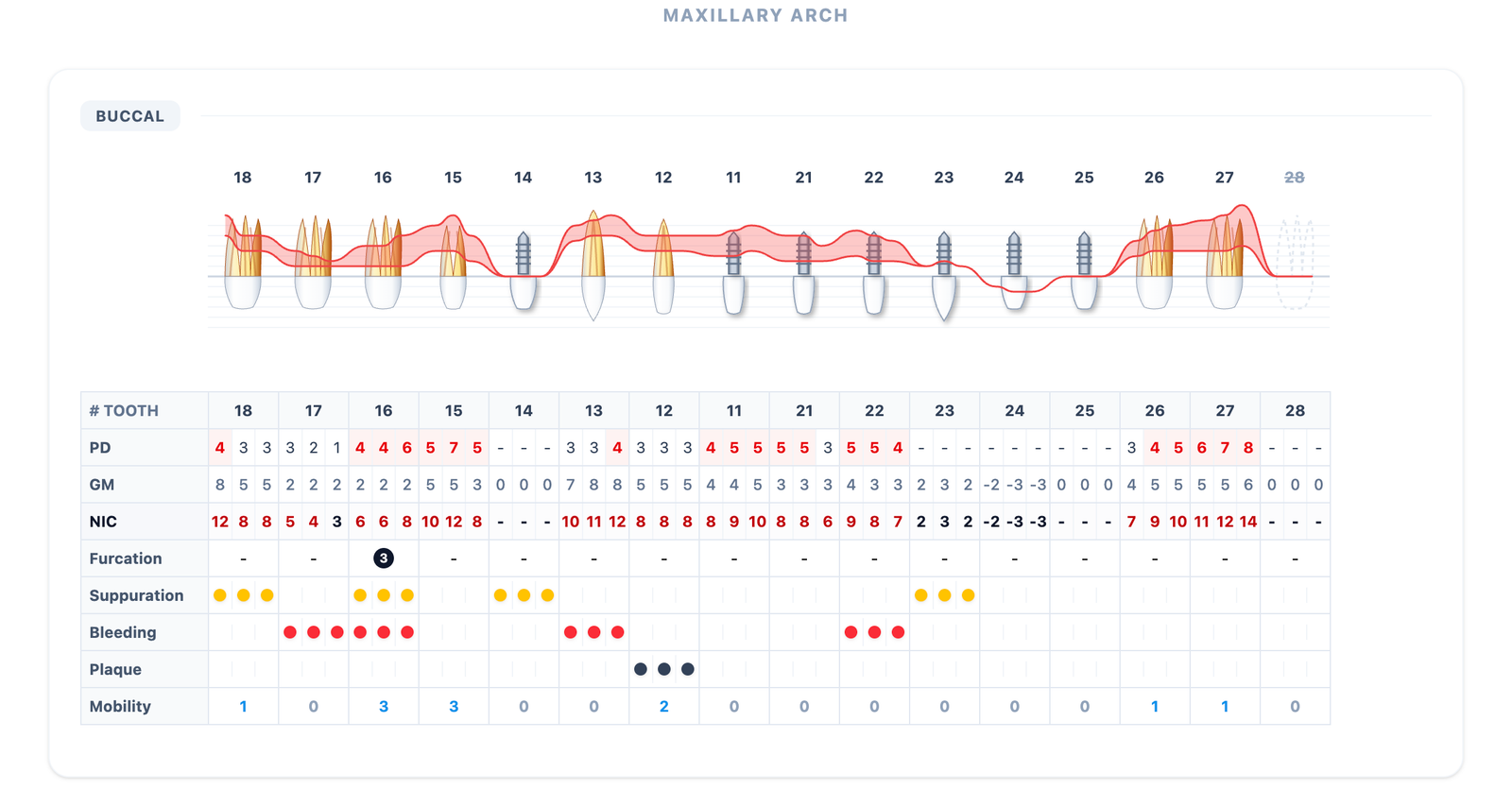
What does the chart record?
The record combines probing measurements with findings linked to a tooth or examination site. In PerioVox, you can document probing depths, gingival margin or recession, bleeding, suppuration, plaque, mobility, furcation and notes. Tooth status matters too: a natural tooth, an implant and a missing tooth are represented differently.
| Record | What it contributes |
|---|---|
| Probing depth | A measurement in millimetres linked to an examined site. |
| Gingival margin or recession | The margin position, recorded using the chosen convention. |
| Bleeding, plaque and suppuration | Findings recorded alongside measurements. |
| Mobility and furcation | Tooth-specific observations. |
| Tooth status | Identification of teeth, implants and missing teeth. |
Teeth, surfaces and sites.
Detailed charting can record six sites per tooth: three on the buccal side and three on the lingual or palatal side. Identifying each site makes it possible to revisit and compare its records. A number alone is not enough without knowing its tooth and surface.
The clinician determines the appropriate examination and recording protocol. Periodontal screening and detailed charting serve different purposes; a screening score alone does not describe all changes at an individual site between visits.
From paper to a digital periodontal chart.
A paper chart requires measurements to be transcribed and retained. A digital record organizes them for review, visit comparisons and reports. Its value depends on accurately reflecting the examination, whichever recording method is used.
PerioVox adds voice entry: probe with your usual instrument, speak your measurements and review the resulting chart. Correct a value or return to a previous tooth when needed. Voice is the input method; the probe and the professional’s judgment remain essential.
How to review the record.
A graph helps visualize the record, but does not determine a diagnosis or treatment on its own. Interpretation belongs to the dental professional.
- Check tooth identification and the selected ADA or FDI numbering system.
- Confirm that measurements and findings match the examined sites.
- Distinguish unrecorded data from measured values; a missing entry is not a normal result.
- Compare visits while retaining the context of each examination.
What can you do with PerioVox?
PerioVox is free and always will be. It runs in a web browser, understands dictation in 97 languages and offers its app interface in English, Spanish and French. After charting, compare visits, work with Lang and IDRA diagrams, generate QR-access patient reports and export CSV records.
Frequently asked questions
Is a periodontal chart the same as a dental chart?
No. A periodontal chart documents periodontal measurements and findings. An odontogram represents other dental findings and treatments. Their roles complement one another.
Does PerioVox measure periodontal pockets automatically?
No. The clinician performs the probing and dictates the measurements. PerioVox structures the voice record; it does not perform the examination.
Can I create a periodontal chart for free?
Yes. PerioVox lets you create digital periodontal charts by voice for free, and will remain free. Use your everyday probe and a compatible device with a microphone.
Sources and documentation
Information for dental professionals. Records and support tools require clinical review; they do not replace diagnosis or treatment decisions.